Wednesday night after I received my residence permit and toured the Holocaust Museum I met up with ten other BSM'ers to go to my first opera. We saw Tsiacovsky's Eugene Onegin at the Hungarian State Opera House, which is located right at a stop on the yellow metro line. The yellow line is one the second oldest subway line in the world and is only behind London's Metropolitan Railway. The Opera House itself was built in 1884 and dedicated by Emperor Franz Josef I. Going to the opera felt like traveling back in time. The stations and trains for the yellow metro are much smaller and quainter than the ones for the red and blue lines, which look very industrial. Its akin to go from riding a double-decker Amtrak train between San Antonio and Chicago to a miniature train than circles a zoo. I wore a button-down blue shirt with Wranglers and nice slip-on shoes. I thought about wearing my boots, but decided to save that for the second opera visit. Back in America, I had joked with some friends that Budapest has a surplus of great opera and theater which makes individual ticket prices very cheap. I found out that this is very true. The central upper level tickets to the State Opera House are 1200 forints each, which is $6. This Wednesday, however, they were running a half-off special, so the tickets were 600 forints, or $3. Not bad. I would've even bought popcorn if I saw any, but I didn't.
Only when the opera started did I fully realize that I wouldn't understand any of it. The opera was sung in Russian with Hungarian subtitles displayed above the stage from an LED display. There a lot of people dancing and singing and men and women running to, and then away from each other. During the intermission after the first act, I bought a program which contained a one-page synopsis in English. I now had the gist of what was happening, but the intricacies of the dialog were lost. I had to rely on the actions and intonations of the actors for the changing tide of emotions that the characters were experiencing. In the end I was glad that I went, but next time I'd like to go to a show where I knew what was happening. Sitting through three hours of gibberish isn't fun the second time, even if you're wearing nice clothes.
The next day, Thursday, I finally mailed my Texas absentee ballot application to the Travis County Clerk. I went to the Posta three blocks from my apartment and found that post offices are the same wherever you are. There were about fifteen people waiting in line and I'd thought I'd be there forever, but the line moved quickly. There were four post office employees manning booths to help people and a queue formed behind each one. I got into a line with three people ahead of me and in five minutes I was standing at the counter. I handed the post office employee, who spoke no English, the pre-addressed post card-sized application. I said, "America." She seemed to understand and put a little sticker on the mail and asked for 330 forints ($1.60). In broken Hungarian I asked her how many days it would take to get to Austin. She held up all five fingers on one hand. Later the next day I asked Anna, the BSM student coordinator, what the standard delivery time was. She said with the Hungarian postal service they say it takes a week, but it could take anywhere between one week to two months. I don't even know who's still running for Texas Governor, but if he/she wants my vote they better hope for the best. UPDATE: After talking on skype to my Uncle Ben Larry, who has been encouraging me to vote or register to vote since I was 17 and 10 months old, I realized that I had forgotten to write down which party's ballot I wanted for the primary. I asked him if Travis County would send me both, just in case. No, he said, acting like I was telling a joke. I mailed completed application for a absentee ballot a few days later.
I hustled from the post office over the river to Buda to get to the French Institute to see a Hungarian movie called Mephisto. The Institute had paired with the Budapest Holocaust Memorial Center to show four films, two French and two Hungarian, that were about life in Europe during the Holocaust and Nazism. I had read a short blurb about the event in the Funzine magazine. The movies would be shown in their original language with English subtitles and there would be a panel discussion about the film an hour before screening. The discussion would be in both French and Hungarian. I got to the French Institute fifteen minutes before the movie was screened. The building's modern style stood out among the standard hundred-year-old Hungarian architecture that I'm used to. Once I walked inside I realized that I had no idea where the movie was playing. All the signs and posters that could have pointed me in the right direction where in either Hungarian or French. I thought it was strange that out of two language options I looked to the Hungarian signs for direction. I went up some stairs and found a couple of college-aged students milling around what looked like the entrance to the event. Trying to just blend in and not look like a complete foreigner/American, I walked past everyone and opened the door to what I thought was the film discussion. Two steps later a young woman said in a French accent "Excuse me, please don't go in there." I stopped and asked her if this was the way to the Mephisto screening. She said it was but that the panel discussion was going on and she asked me to enter through the back of the auditorium which was up another flight of stairs. I had ridden the subway, taken a bus, and walked through the cold just to find this place, so I was too tired to ask any more questions. She offered me a set of headphones connected to a radio for a translation of the discussion. I took it graciously, hoping that it included an English translation. One floor up I did not see any indication of the door to the auditorium. I found a man walking out a library down the hall and asked him if he knew where the auditorium was, but he immediately begin speaking in French and shrugging his shoulders; he didn't speak any English. "Italiano?" No, I shook my head. I tried to think of the word for theatre or movie in Hungarian, but it escaped me -- I should've known them, too; Szinhaz = theatre, Mozi = movie. We both stood there, dumbstruck, utterly unable to communicate. I thought about my friend Alina in Paris who can speak both Italian and French and about the immense help she would've been at the moment. I said thanks to the guy and walked downstairs where I chanced opening a door which turned out to be the one I was looking for.

The auditorium was a college lecture-style room. There was a long table down at the stage where four people sat. I had entered at the top of the room behind everyone in the stadium seats. I took a seat in the middle of the last row and relaxed. The panelists were alternating between Hungarian and French and the headset that the woman had given me gave real-time translations of what they were saying in the opposite language. I couldn't listen to them in English, since the device had only two working channels: one for Hungarian and one for French. Looking around the room, it seemed as if half of the people were wearing their headsets at any given time, so half of the students must have been French and half were Hungarian. When the panel discussion was over, a stream of a few dozen students entered the room immediately on the right hand side of the stage. That must have been the entrance that the young woman stopped me from going into. I felt a huge sigh of relief that she had saved me from looking like an idiot, walking out on stage wearing two jackets and looking like hell in front of everybody. After the show I tried to find this person to thank her but I couldn't.
The movie itself was very interesting. It was about an actor in 1930's Germany, who is virulently against the Nazi Party, but allows himself to become involved in state-sponsored theater even though his friends are being rounded up for anti-Nazi activities. It's about complicity in the face of evil. Its about silence. I had expected to see something about Jews or the crimes of the Holocaust, but the film focused on the actor in Germany. In fact, the entire movie was in German with English subtitles. What? So the same people who sat for a discussion in French and Hungarian were now watching a movie in German with English subtitles? Did everyone in the room speak at least two languages? Europe is crazy. The movie is a famous Hungarian film, made by a Hungarian director, but there was only five minutes of anything Hungarian in the movie. The main character was in Budapest filming a new movie and it showed a panorama of the city and the river during the day, but that was it. It was still great to watch. I think that the story followed Goethe's Faust, though I have never read it.
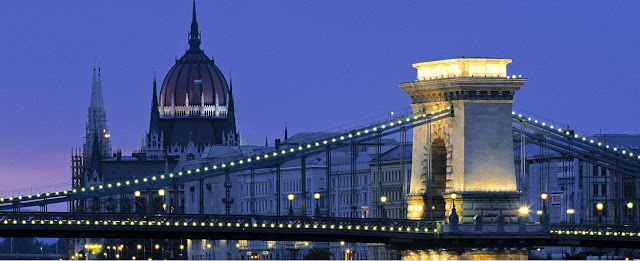
One thing, though, that I thought was great, were the people who sat next to me in the auditorium. A guy had clearly brought his girlfriend to see a movie about the Nazis. They were holding hands and hugging throughout the two-hour movie. Why did I keep looking? Who takes his date to see a movie about Nazis? Oh, yeah. Alvy Singer. I couldn't believe that I was seeing life imitate art. I immediately recalled Alvy Singer taking Annie to go see "The Sorrow and the Pity" repeatedly in the movie Annie Hall. Wow. I had to restrain myself from laughing. After the movie I walked back to Deak ter across the Chain Bridge. I love the bridges in Budapest. Here's a parting shot.



 Posts
Posts

