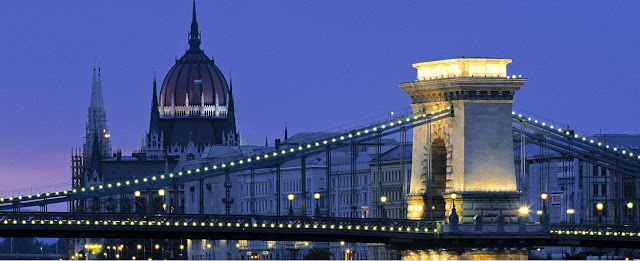
Chain Bridge, Budapest
Showing posts with label holocaust. Show all posts

Tuesday, May 18, 2010

The Return

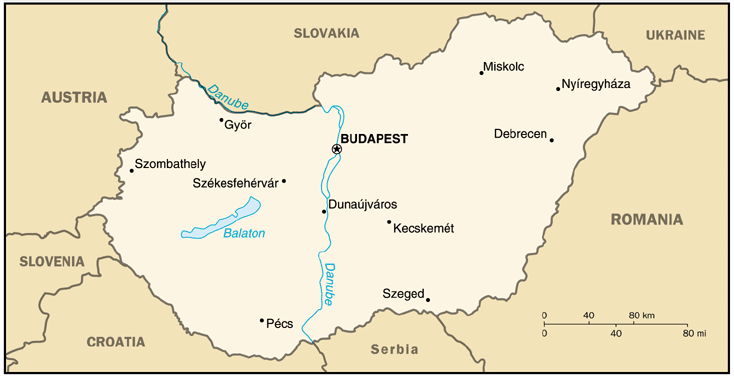
(Yaawwwnnnn....) Oh, hello. Good morning. Jo reggelt kivanok. It's so nice to see you again. I feel like we haven't spoken in ages. I'm on the home stretch for my semester with BSM and the finish line is in sight. The coursework has become harder and the weather has become nicer, which has lead to some inconsistent study habits to say the least. I've also been travelling a lot. Last time I checked in with y'all I was about to head to Krakow, Poland. I made it there and back with a detour at Auschwitz. I can write a whole essay just on that trip alone, but I'll jot down some thoughts now and save the exposition for later. Two weekends after that I rented a car with eight other people and drove to Croatia, stopping at the beautiful Plitvice Lakes and ancient Split on the Adriatic Coast. In between these trips out of town, I explored Budapest some more as well. On May 1 a May Day carnival was held in Varosliget (City Park). Last week I finally visited the famous Dohany Synagogue in Budapest. Two days later my roommate Andy and I rented bicycles and went statue hunting around Budapest to collect pictures for my Hungarian class project.

I've uploaded nearly 1000 pictures to my online Picasa album as evidence of these escapades. You can always view my entire photo library from time in Europe by clicking on the permanent link on the top right hand corner of this web page, or for convenience you can also click right here. Here are a few of the highlights from the past month:

Thousands of Polish law enforcement officers line the streets of Krakow in preparation for the funeral of a civic leader killed in the tragic plane crash two weeks prior.

At the loading dock inside Birkenau, where 1.1 million Jews and Poles were killed. 400,000 Hungarian Jews died at Auschwitz during the Holocaust, the most Jews from any single country killed there. Most people were unloaded from the trains where I am standing.

Getting a picture with the conductors of the train right before we left from Krakow to Budapest.

Karl Marx greeting people near the literature tables for the local communist party on May Day in Varosliget

 One of the many waterfalls of crystal clear water at the Plitvice Lakes, Croatia

A view of Diocletian's Palace in the historic old town of Split, Croatia. We had just finished swimming in the Adriatic Sea, pictured in the background.

Inside the Dohany Synagogue in Budapest. It is the second largest synagogue in the world and the largest in Europe. As you can see, it has three tiers of seating.

Hanging out with Attila Joszef, the most famous Hungarian 20th Century poet. This statue is directly south of the national parliament on the Danube in Budapest. 

Already reminiscing, my trip to Krakow almost didn't happen. I had been taking my time finishing my homework and nearly flaked out on my buddy Dan to go visit Krakow and Auschwitz. I asked my roommates in passing if they wanted to go also, and they immediately jumped on the adventure. Their enthusiasm and Dan's encouragement got me back on the wagon and onto the train headed for Krakow. 

The four of us were in a 6-person couchette. There were two other people with us, filling up the tiny sleeper compartment. One was an American girl, a student at Smith College who was studying abroad learning computer science in Paris. She was on her spring break and was traveling across Central Europe. The other guy was a Hungarian in his late 20's, traveling in a triangle from Krakow to Ukraine and back to Hungary. He was a transport engineer working for BKV, the Budapest public transit company. He told me that the 4,6 tram line that runs around the big körut, the tram that I take at least once a day, has the highest traffic of any tram line in the world, and it even has more traffic than Budapest's Metro line 1, which is the second oldest in the world. 

This was my second time to Krakow and Auschwitz. (For reference, the Auschwitz death camps are located in the Polish town of Osweichem, which is an hour's bus ride east of Krakow.) My first trip was with the March of the Living back in April 2006, four years ago to the month. On this trip I saw many of the same sights. We strolled through Kazimierz, the medieval Jewish quarter of Krakow, and visited Auschwitz. By chance, the four of us walked the 3 kilometers from Auschwitz I to the larger Auschwitz II - Birkenau. I had made the same journey four years ago on Holocaust Remembrance Day with ten thousand other Jewish high schoolers from around the world. This time it was just the four of us. For me visiting Poland for the second time was much different from the first, particularly since I had been living in Central Europe for four months before this recent trip. The most lasting thought I had from the first trip was that I could never live in Poland, ever, and I couldn't imagine anyone wanting to live there. I had thought that living in Poland must be like living in a graveyard. Unclean and unholy. Many of my friends on the March of the Living felt the same way. 

Now that I have lived in Budapest, Krakow seemed really cool. I really liked the medieval architecture and the hip vibe that the city had. It was similar to Budapest, but much older and less urban. As I we drank coffee in an outdoor cafe in a small park on a beautiful sunny afternoon, I remembered my aversion to Poland from four years ago. I felt very hypocritical. Hungary experienced nearly as much death and destruction as Poland, and Budapest was nearly flattened during the war. In fact, Hungary was notorious for allowing the fascist Arrow Cross party to deport Jews to their deaths at an alarming rate, quicker than the Germans were doing in other countries. The exhibit at the Auschwitz Museum dedicated to the destruction of Hungarian Jewry was titled "A People Betrayed." The city of Budapest itself is covered with Holocaust memorials, remembering the victims of the Arrow Cross. Does that same gut reflex I had four years ago in Poland apply to my time in Budapest today? Not really. What does that mean? I don't know.

Okay. Must go to sleep. Will try to update more on the Krakow trip, as well as Croatia, and statue hunting in Budapest, and my inevitable trip to the Dohany Synagogue. Wish me luck on finals.

Friday, April 23, 2010

Off to Poland...

Hey everyone. I only have a few minutes before I must catch the overnight train to Krakow, Poland. I'm travelling with my two roommates Mike and Andy as well as my BSM friend Dan Munger. We are going to see the old city and the Jewish quarter of Krakow. Of course, no trip to Krakow would be complete without taking the short bus ride to Auschwitz-Birkenau outside of the city. I've been there once before, four years ago to the month with the San Antonio delegation of the March of the Living, 2006. It will be Dan, Mike, and Andy's first time to visit Auschwitz. I'm sure it will be a very moving experience for all of us. I will post pictures and full essay about the trip when I return. We are taking the 10pm overnight train back from Krakow on Sunday night to arrive at Budapest at 8:30am Monday morning. I have class the same day at 10:15am. Giddy-yap.

On a happier note, I met another AEPi brother today. I wore my burnt orange AEPi hoodie to school and AJ Trenk from California State University-Northridge saw me and introduced himself as a fellow brother. He's in the McDaniel College pre-medical program here for the semester. McDaniel College, which is in Maryland, has a Budapest campus which uses the same building that BSM uses. AJ is a junior at CSUN. I've met many Californian AEPi's from previous conventions and conclaves on the west coast. They are always the most spirited and are the strongest chapters in the country. I knew it would only be a matter of time before I ran into a Pi. On a similar note, last Monday Leah texted me that she spotted a guy wearing a Texas Longhorns baseball shirt at the KFC (yes, thats Kentucky Fried Chicken) by the Keleti train station. I was down the street at school with a minute to go before my Hungarian class started. I briefly, but thoroughly, considered skipping the first part of class and running down the street to say "hook 'em" to the fellow longhorn. I was wearing my Hex Rally shirt at the time and I thought it was appropriate. Alas, just then Erica the teacher walked in to say jo napot kivanok! and class started.

'Till next time, may the eyes of Texas be upon you.

Thursday, April 15, 2010

Yom Ha'Shoa

Monday was Yom Ha'Shoa, Holocaust Remembrance Day. The Israeli Student Organization in Hungary (ISOH) sent me a Facebook invite to their ceremony held in the original Pava utca synagogue next door to me. After my long day at school, I met Rebecca Garber from BSM at the synagogue to attend it together. The fold-away seats set in the restored synagogue were nearly full of people, young and old. Everyone wore white, which is what the event's organizers had encouraged people to do. The room was about two-thirds full of college aged students with the remaining third made up of families and even some Holocaust survivors. Unfortunately the hour long program was entirely in Hungarian and Hebrew, so neither Rebecca nor I understood anything. After the ceremony ended I looked around for any of the Jewish Hungarians I had met earlier at the community Friday night services, but I didn't see anyone.

I went home quickly to change back into street clothes to go to the Balint Haz. The ISOH had also sent a mass Facebook invitation to watch the movie Europa Europa, the true story of Solomon Perel, a German-Jew who survived the Holocaust by fleeing to Poland, becoming a Russian Komsomol youth officer, was captured by the Germans but hid his Judaism by convincing the soldiers that he was an ethnic German living outside the fatherland. He served as a German-Russian translator on the front and helped capture Josef Stalin's son. Later he was enrolled in the Hitler Youth back in Berlin and fell in love with a teenage girl who was a fervent Nazi. His story is too crazy to be true, and the movie is carried by the nearly fantastical series of events that eventually led to his liberation. A large part of the movie deals with Solomon hiding his circumcision from his friends, which would have immediately given him away. I couldn't help but remember the endless discussions on Philip Roth's The Counterlife that my Jewish literature class had last semester. I would highly recommend The Counterlife for anyone not looking for a simple, straightforward, easy, and certainly not introspective read. 

I had never been to the Balint Haz before. Its only one block off of Andrassy, the famous boulevard for Hungarian aristocrats under the Empire. The Balint Haz is a sort of small Israeli/Jewish community center. Rebecca didn't come to the movie with me, but she was at the Balint Haz anyway participating in her weekly Israeli dance group. Once I found were the movie would be shown, I introduced myself to the few people from ISOH who were setting up snacks. They were all Israeli and spoke English very well and made me feel at home. I had arrived ten minutes early and soon twenty other Israelis had come upstairs to fraternize and watch the movie. Everyone chatted away in Hebrew, and I didn't want to be that guy that made everyone speak English, so I waited for the movie to start. Afterwards 15 people hung around to have a discussion about the movie. They encouraged me to stay, saying that there was a Hungarian man who didn't speak Hebrew so the discussion would be in English for our sakes. 

One of the girls in charge asked people to share stories about the war from their own family's history. This is where I felt really out of place. Almost everyone had a story about how their family traveled around Europe or went to Israel to escape the Nazis and later the communists. Luckily, my grandparents and great-grandparents left Europe in the 1920's, before the rise of Nazism. The discussion then turned to Jewish identity under communism and in today's Hungary. The topic was particularly on people's minds since the day before was the national election in which the extreme right wing party won a 16% share of Parliament. The question of Jewish identity (what is it? how do you define it? can someone be "more" Jewish than another?) never has a clear answer. The conversation among the Israelis and Hungarians became a little heated and comments were flying across the room so fast it was hard to keep track. I wanted to throw in my two cents, but I struggled to find a significant American perspective that I thought they would like to hear. Let's face it, American Jews have it pretty well off compared to other Jews around the world, including Israel. As Americans we thoroughly exercise our First Amendment rights to freedom of religion and speech nearly everyday. Its very rare that I hear stories of true anti-Semitism in America and many of my Jewish friends aren't afraid of displaying their religious observance openly in society. Its taken a while, but today religious discrimination in America is regarded as taboo, something that's archaic. 

In Hungary, however, I have heard a few Hungarian Jews tell me about their fear of openly displaying their Judaism, or telling new friends that they are Jewish. This issue dominated the discussion for a while and several people volunteered to share their own stories and observations. I hadn't realized just how widespread this phenomenon is. Everyone agreed that the situation for Hungarian Jews was improving in spite of the rise of European anti-Semitism. Much of the community's increased strength in the face of intolerance is due to many young and old adults suddenly discovering their Jewish heritage from an aging grandparent's revelation of Jewish blood in the family. A representative of the Jewish Agency who took part in the discussion said that for the past few years, the majority of Taglit Birthright participants from Hungary have been young people who just discovered their Judaism in their 20's. These fundamental differences separate the community that I'm used to in America with that of Hungary and the rest of Eastern Europe. Our backgrounds are totally different. I learn so much from each new person I meet here. Its a little overwhelming.

Now its late again and I have to go to bed. I hope that my blog doesn't reek of "Jewishness." I've tried to post on a variety of subjects about my life in Hungary, but I keep getting drawn back into talking about Judaism. It was already such a big part of my life that its hard to ignore it. Plus, its turning out to be hard to ignore it in Budapest. As one Israeli who I met at the movie screening told me, "everywhere you look in Budapest has some sort of Jewish element to it." He is completely right. As if by natural instinct, nearly all of the bars, dance clubs, music clubs, and restaurants that the BSM students go to are populated by Budapest Jews or are located in the Jewish district. The Israeli said that Budapest has been the most Jewish city he has ever lived in.  Pretty remarkable, eh?

As a throwback to my DJ'ing days at the student radio station KVRX, I'm now taking requests for blog topics. My English teachers would call this a very uncreative move. I call it giving the power to the people.

God Bless America.     

Thursday, February 4, 2010

Residence Permits and Holocaust Museum

Today the whole BSM group went together to the local Hungarian Immigration Office to get our residency permits. We had all applied for and received visas from the Hungarian Consulate in New York before we had left, but now we needed to get the proper documentation that made our 5 month stay in Hungary legal. We went to the math school at Bethlen Gabor Ter at 8 a.m. to Anna's, the BSM student coordinator, office to print and fill out any last remaining paperwork. We left the school at 9:30 p.m. to hop on a bus at the nearby Keleti Train Station to go the immigration office in Buda, across the river and on the other side of town. There were about 30 of us in the pack and the first 10 people were able to catch an earlier bus while the rest of us, including Anna, waited at Keleti for another bus which came in 5 minutes. Meanwhile, Anna got a phone call from Brittany, who had gotten on the first bus. Apparently, for whatever reason, the public transit employees had ordered everyone off the bus after just one stop. The Hungarian passengers started yelling and cursing at the employees while the Americans walked off the bus confused. Anna laughed at this information, but wasn't surprised. "This happens from time to time," she said. We met up with the rest of the group and took the tram to the immigration office.

The immigration office wasn't such a painful experience. There were only three other people in line when we arrived, so we took up essentially the whole office. Anna did a great job talking to the immigration officers and handling all of the paperwork. All we had to do was take a seat and wait for our name to be called. They had plenty of comfortable chairs and tables so it wasn't a problem. Some people read, others conversed, a few twiddled Rubik's cubes. Not a big surprise there; turns out several of the BSM'ers can solve a Rubik's cube. The real question is how fast can they solve it? or have they ever done a 4x4 cube? Ranjan, from Philly, said in his prime he could solve a cube in under 25 seconds. Today he did one in about 35 seconds. I have never solved a Rubik's cube, or even solved one side. While we waited, David Stapleton, from Minnesota, quickly taught me how to do one side. Once you know the right way to manipulate the cube, its surprisingly easy to get one side. I felt like I had earned half of my math degree right then and there. After struggling to finish solving the remainder of the cube, I asked Kira, who was sitting next to me, if she had ever solved a Rubik's cube. She said she had not, so I let her try to finish it. She quickly solved 90% of the cube without hesitating. I said, "I thought you couldn't solve a Rubik's cube?" "I can't" she replied, "I can never get the last few pieces." She still was a helluva lot better than me. David, Kira and I fiddled with the cube for while longer, solving it then making a few turns and trying to fix it. The experience makes me want to get my own cube and try to solve it. It would be appropriate since I'm living in Budapest, the home town of the inventor of the cube, Erno Rubik.

After getting my residence permit, I headed home where I collapsed on my couch for an hour long nap without taking off my shoes. When I woke up, I headed outside to check out the Holocaust Museum next door. I had received my International Student ID Card yesterday and I wanted to use the discount to finally visit the museum. There were nearly no other people in the museum besides a handful of employees. The museum itself is very new, modern and well designed. The complex is built adjacent to an old existing synagogue, which was donated to the museum in 1999. The entire area is about half of the small city block, which is relatively little space compared to the United States Holocaust Museum in Washington D.C. and especially Yad Vashem in Jerusalem. Its amazing, though, how the designers were able to pack so many meaningful exhibits and monuments into such a small place without feeling cramped. It had snowed all week making the courtyard a clean blanket of white powder, and the high walls of the complex prevented outside traffic noise from seeping in. I was completely alone in the snow. I had read about what had happened to the Jews in Hungary before, but I had never learned about it in this way. I wasn't looking for it, but the exhibits and the building itself forced introspection onto me. Even without a tour guide, just wandering alone through the exhibits provided insight and was a very worthwhile experience. Here is the link to the Hungarian Holocaust Memorial Center, and here is another link within that website that talks about the building.

It's late and I have to go to sleep. Here are the pictures I took today. I also went to the State Opera House to see Tsaikovski's Eugene Onegin. It was another amazing experience that I'll relate tomorrow, but feel free to check out the pictures.